

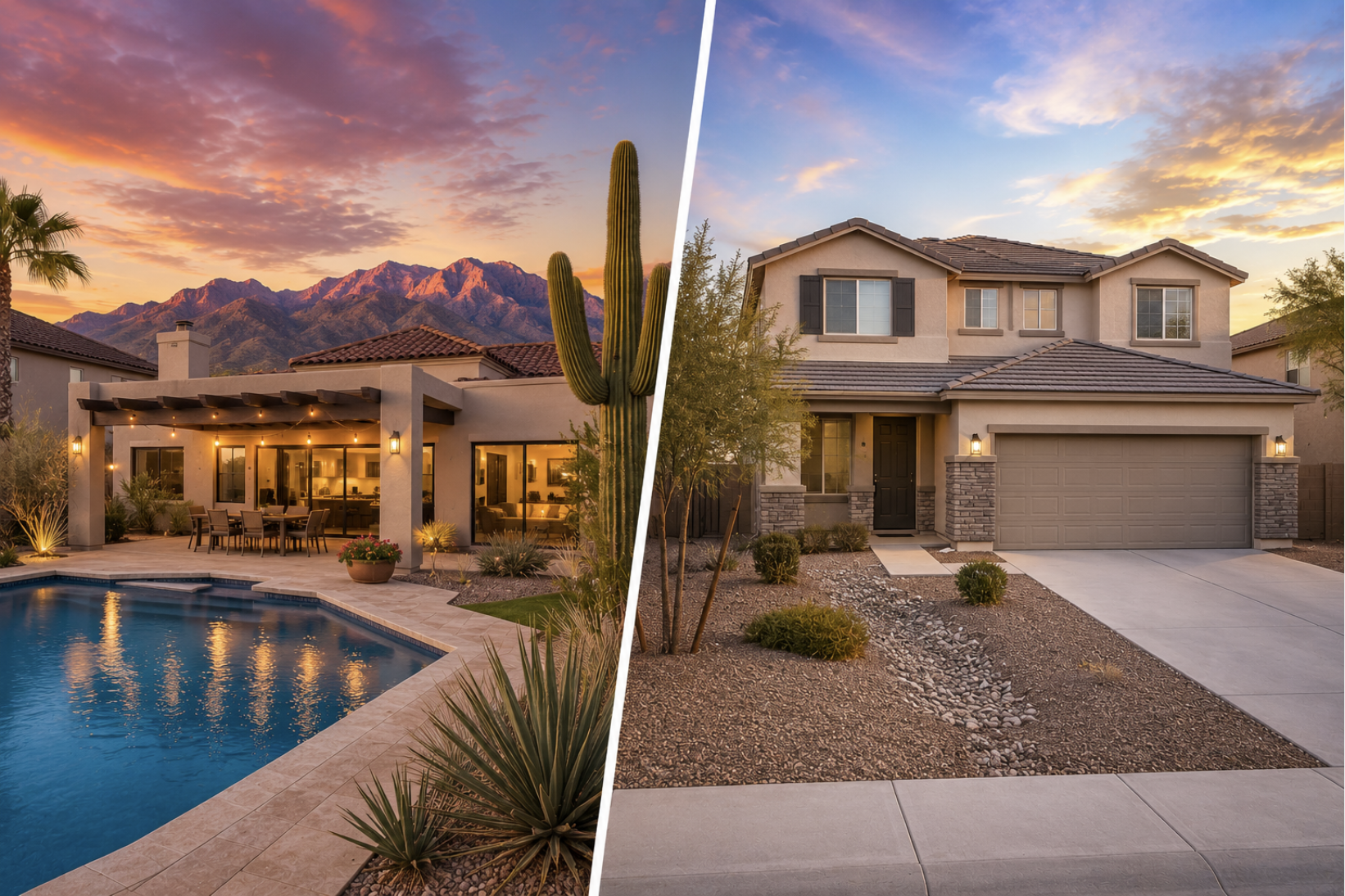
You're scrolling through Phoenix homes for sale and find two properties at almost exactly the same price.
One has a pool and renovated kitchen but less square footage.
The other is larger, newer, and has an extra bedroom—but it's farther from the places you visit every day.
Then you find a third.
It's older, has no pool, and isn't nearly as updated, but it's sitting on a larger lot in a location you love.
Which one is actually the better buy?
Welcome to one of the most interesting parts of house hunting in Phoenix.
Two homes can have nearly identical asking prices and provide completely different ownership experiences.
That's why comparing homes based solely on price—or even price per square foot—can miss some of the things that matter most.
Here's what Phoenix buyers should compare before deciding where their money goes further.
1. You're Buying a Location Before You're Buying a Kitchen
Imagine two homes listed for the same amount.
Home A has a gorgeous remodeled interior but adds significant time to your daily commute.
Home B has an older kitchen but puts you much closer to work, restaurants, family, or the places you regularly visit.
Which one has more value?
That depends on you.
The important point is that kitchens can change.
Location can't.
When comparing Phoenix properties, map out your real routine. Don't just check how far the home is from downtown.
Think about:
- Work
- Airport
- Grocery shopping
- Healthcare
- Family
- Restaurants
- Recreation
- Schools, when applicable
- Places you visit every week
A home isn't truly convenient because the listing says it is.
It's convenient when it works for your life.
2. Square Footage Doesn't Tell You How Big a Home Feels
Buyers naturally compare square footage.
But you've probably experienced this during a showing:
A smaller home somehow feels bigger than the larger one you toured earlier.
Layout matters.
A well-designed floor plan can make better use of space, while an awkward layout can make additional square footage surprisingly unhelpful.
Look at where the square footage is going.
Is there a formal dining room you'll never use?
Long hallways?
An oversized primary bedroom but tiny secondary rooms?
A useful home office?
Good storage?
Open living areas?
Don't automatically assume the larger Phoenix home is giving you more usable space.
Walk through your normal routine mentally.
Sometimes 1,800 well-designed square feet can fit a buyer better than a larger home with the wrong layout.
3. A Pool Changes the Equation
Now suppose one of those similarly priced Phoenix homes has a pool.
The other doesn't.
The pool home may immediately feel like the better deal.
Maybe it is.
But compare what you're actually getting.
A pool takes up backyard space and comes with equipment, maintenance, water, electricity, cleaning, and eventual repair needs.
For a buyer who swims frequently, entertains outside, or genuinely wants a pool, those responsibilities may be completely worthwhile.
For someone who will use it twice a year?
Maybe not.
Don't automatically assign value to a feature simply because Phoenix is hot.
Ask yourself how much you value it.
4. An Older Home Can Compete With a Newer One
Age can influence buyer perception.
A newer home may have newer building systems, contemporary layouts, and modern finishes.
But an older Phoenix home may offer something completely different: an established location, mature landscaping, different architecture, or a lot that would be difficult to find in newer development.
Condition matters more than the year alone.
An older property could have an updated roof, HVAC, windows, electrical components, and remodeled interior.
Meanwhile, a newer property can still require maintenance.
Instead of asking:
"Which home is newer?"
Ask:
"What condition is each home actually in?"
That's a much more useful comparison.
5. That New Kitchen Might Be Distracting You
Buyers love renovations.
And sellers know it.
Fresh flooring, new countertops, modern cabinets, updated lighting, and neutral paint can completely change your emotional reaction to a house.
Try this experiment:
Mentally remove the renovations.
Would you still want the home?
Do you like the lot?
The street?
The layout?
The natural light?
The backyard?
The commute?
The location?
Now do the opposite with the less attractive property.
Imagine new paint, flooring, and fixtures.
Does it suddenly become a stronger option?
Cosmetic improvements are important, but they're also among the easiest aspects of a home to change.
Don't let someone else's design choices outweigh the fundamentals.
6. The HVAC System Isn't Exciting—Until You Own It
Imagine one Phoenix home has beautiful new flooring.
The competing property has older flooring but recently updated cooling equipment.
Which upgrade would you rather inherit?
There's no universal answer, but Phoenix buyers should pay close attention to HVAC systems.
Ask about the age, condition, configuration, and available maintenance history of the equipment.
Your home inspection can provide more information and identify concerns that may warrant additional evaluation.
A house isn't just what you see.
Some of its most important components are also the least photogenic.
7. Lot Size Can Completely Change the Property
Two similarly priced Phoenix homes might sit on dramatically different lots.
One may have a compact, low-maintenance backyard.
The other could provide considerably more outdoor space.
Neither is automatically better.
Think about what you want to do with it.
Do you want a pool?
A garden?
Room for pets?
Outdoor entertaining?
Or do you want as little yard maintenance as possible?
Also consider the shape and usability of the lot.
A larger lot isn't particularly valuable to you if most of the additional space is somewhere you won't use.
Compare usable outdoor space, not simply lot dimensions.
8. Mature Landscaping Has Value You Might Not Notice Immediately
A newer Phoenix home may come with fresh desert landscaping and young trees.
An established property could have mature vegetation providing significant shade.
Those yards can feel completely different.
Mature landscaping can add character and make outdoor spaces more comfortable, but it can also require maintenance.
Look at tree condition, irrigation, placement, roots, and proximity to the home.
Likewise, don't assume a newer landscape is automatically easier.
Understand what each yard will require after closing.
9. HOA Fees Can Change Your Monthly Comparison
Two houses may have the same asking price while carrying different ongoing expenses.
One could be in an HOA community.
The other may not be.
Or both could have associations with different assessments, amenities, and responsibilities.
Don't compare only mortgage payments.
Review applicable HOA fees and documents and understand what you're receiving—and what you're responsible for.
A community with amenities you use regularly may be worth the expense to you.
Paying for features you don't care about may feel very different.
Also review rules that could affect how you plan to use or modify the property.
10. The Garage Can Be More Important Than You Expect
Phoenix buyers sometimes treat the garage as a simple checkbox.
Two-car garage?
Done.
Look closer.
How much usable space is actually inside?
Will your vehicles fit comfortably?
Is there storage?
Where is the water heater or other equipment located?
Does the garage face afternoon sun?
Is there room for bicycles, tools, or hobbies?
If you plan to park inside regularly, test whether the garage works for your vehicles and lifestyle.
An extra bedroom gets more attention in listing photos.
A functional garage might affect your daily life far more.
11. New Construction Has a Different Kind of Price Tag
A new Phoenix-area home may look competitive next to a resale property.
Just make sure you're comparing complete costs.
An advertised base price may not represent the finished home you pictured.
Depending on the builder and property, buyers may need to consider items such as:
- Lot premiums
- Design upgrades
- Landscaping
- Window coverings
- Appliances
- HOA assessments
- Backyard improvements
- Other finishing costs
Compare the actual home you'd purchase with the actual resale alternative.
"Starting from" and "move-in ready" aren't necessarily equivalent numbers.
12. Your Commute Has a Cost Too
Suppose moving farther from your regular destinations gets you another bedroom, a larger yard, and newer construction.
That can be an excellent trade.
But acknowledge the other side of it.
More driving means more time spent in the car.
Test important routes during the times you'd normally use them when practical.
Ask yourself whether you'd rather have the additional house—or the additional time.
Different buyers will answer differently.
That's exactly why two homes at the same price can represent completely different value.
The Phoenix “Same Price” Test
When you're stuck between two Phoenix homes, make a simple comparison.
| Question | Home A | Home B |
|---|---|---|
| Location | ||
| Commute | ||
| Usable square footage | ||
| Lot | ||
| Pool | ||
| HVAC condition | ||
| Roof condition | ||
| Renovations | ||
| HOA costs | ||
| Outdoor shade | ||
| Garage | ||
| Immediate repairs | ||
| Overall lifestyle fit |
Then ask one final question:
If both homes had identical paint, furniture, and countertops, which one would I choose?
That's often where the answer becomes clearer.
FAQs About Comparing Homes in Phoenix
Why can two Phoenix homes with the same price be so different?
Location, lot size, home age, condition, renovations, pools, HOA obligations, floor plans, garages, landscaping, and proximity to amenities can all affect a property. Asking price alone doesn't capture those differences.
Is price per square foot important when buying a Phoenix home?
It can provide one point of comparison, but it shouldn't be used alone. Location, condition, lot, upgrades, property type, views, amenities, and other characteristics can make two homes with similar square footage very different.
Is a larger Phoenix home always a better value?
No. A smaller property may have a better location, more useful floor plan, larger lot, newer systems, or features that matter more to you. Compare how you'll actually use the home rather than square footage alone.
Should I choose a Phoenix home with a pool?
Choose a pool home if the feature fits your lifestyle and you're comfortable with its maintenance and operating responsibilities. Buyers who don't expect to use a pool may prefer to prioritize other features.
Is an older Phoenix home a bad investment?
Age alone doesn't determine whether a property is a good purchase. Condition, maintenance, location, renovations, major systems, price, and the buyer's goals all matter. Evaluate the specific property rather than relying on its construction year.
Are renovated homes worth paying more for?
They can be, depending on the quality and extent of the renovation. Buyers should distinguish cosmetic improvements from upgrades to major systems and investigate substantial previous work where appropriate.
Should I consider HOA fees when comparing Phoenix homes?
Yes. HOA assessments affect ongoing ownership costs. Buyers should also review what the association provides, applicable rules, financial information, and responsibilities before comparing an HOA property with a non-HOA alternative.
Is location or house size more important?
That depends on the buyer. Someone who works from home may prioritize space, while a daily commuter may place greater value on location. Decide which factors most affect your everyday life before comparing properties.
How do I decide between two Phoenix homes I love?
Compare the factors that are difficult or expensive to change: location, lot, layout, major systems, commute, HOA obligations, and overall condition. Then consider cosmetic features and personal preferences.
In Phoenix, the Best Value Isn't Always the Biggest House
House hunting would be much easier if the highest square footage at the lowest price automatically won.
Real estate doesn't work that way.
Two Phoenix homes at the same price can offer completely different lifestyles.
One might give you a pool.
Another gives you an extra bedroom.
One puts you closer to work.
Another gives you a larger lot.
One has a brand-new kitchen.
Another has less exciting finishes but major systems that have already been updated.
That's why the smartest comparison isn't simply:
“Which house gives me more?”
It's:
“Which house gives me more of what actually matters to me?”
Once you answer that, choosing between two Phoenix homes can become a lot easier.
Check out this article next